
But unstructured practice creates a real problem. Players rack up touches without knowing which skill they're building or whether it actually shows up in matches. A player might spend 20 minutes on toe taps and never connect that work to receiving under pressure during a game.
This guide breaks down the main categories of solo drills, how to adjust them for different skill levels and goals, and how to build a routine that actually transfers to the field.
Key Takeaways
- Purpose-built solo drills sharpen ball control, first touch, finishing, and game awareness.
- Pair technical reps with movement, weak-foot work, and scanning cues.
- Match each drill to position, current weakness, space, and available equipment.
- Track quality and decision-making, not just repetition counts.
What Is Solo Soccer Training and Why Does It Matter?
Solo soccer training is structured, independent practice using a ball, cones or markers, a wall or rebounder, a goal or target, and sometimes a phone for video review. Done well, it is a planned session with clear goals, not casual kicking around.
Individual work builds repeatable technique, comfort on both feet, and confidence before those skills get tested against real opponents. A player who can juggle 100 times but panics on a first touch under pressure hasn't actually developed the skill in a way that matters.
Repetition without technique just rehearses bad habits. Players need:
- Proper form on every touch, not just fast touches
- Controlled progression from slow to game-speed
- Realistic movement patterns, not stationary drilling
- Game-related cues like scanning before receiving
Why Solo Training Works for Competitive Players
Individual sessions let players isolate weaknesses without waiting for a coach's attention. A midfielder who struggles with body orientation before receiving can repeat that exact scenario dozens of times in 20 minutes. That kind of focused repetition is hard to get in a full team practice with 15 other players competing for reps.
Solo sessions also help competitive players:
- Isolate one weakness and stack high-quality reps in a short window
- Train both feet and first touch without waiting for a coach's rotation
- Fit technical work around school, matches, and recovery
- Build confidence before those habits get tested in games

The Limits of Training Alone
Those upsides still have a ceiling. Solo drills can't reproduce defender pressure, teammate movement, or the chaos of a live match.
A player might nail a cone-based Cruyff turn a hundred times, then freeze the first time a real opponent closes at speed. Solo training should complement team practice, small-sided games, and coached feedback—not replace them.
Types of Solo Soccer Training Drills
Solo drills work best when grouped by the skill or match outcome they build, not treated as a random grab-bag of moves.
Technical Foundation Drills
These build the base: juggling, toe taps, inside-outside touches, sole rolls, ball pulls, and ball mastery patterns.
- Juggling: keep the ball below hip height to build touch on both feet
- Toe taps: quick alternating taps on top of the ball for rhythm and ankle control
- Inside-outside touches: move the ball across the body while staying on the move
- Sole rolls: drag the ball with the sole to change direction without exposing it
FIFA's Training Centre identifies close control, correct body movement, and space awareness as the core components of ball mastery that help young players retain possession and beat defenders during matches FIFA Training Centre. The same source flags fixed eyes on the ball and a rigid, upright posture as habits that limit progress.
Progressions to try:
- Alternate feet every few touches instead of favoring the strong side
- Increase touch speed once control stays consistent
- Move through space rather than staying planted
- Combine a ball-mastery pattern with a sudden change of direction
Common errors: standing too upright, taking heavy touches that push the ball too far away, staring at the ball the entire time, and sacrificing control just to look fast.
Dribbling, Turns, and 1v1 Movement Drills
Cone weaving, direction changes, ball rolls, inside/outside cuts, and pull-backs all build close control and attacking movement.
To make these game-like:
- Approach a marker at speed instead of jogging into it
- Change pace immediately after the move
- Scan the space before committing to the turn
- Accelerate into open space right after the touch
Add progressions like tighter cone spacing, both-foot execution, and weaker-foot exits. Practicing a move cleanly is not the same as knowing when to use it in a match. Cone work teaches the first skill, not the second.
Passing and First-Touch Drills
A wall, rebounder, or flat surface lets a player pass repeatedly with the inside of both feet, receive across the body, and cushion the ball into the next touch.
Vary these to avoid a repetitive two-touch loop:
- Distance and angle of the pass
- Pass speed (firm versus soft)
- Body orientation before the ball arrives
- Which foot receives the ball
Scanning matters more than most players realize. A 2025 study of 45 elite U12–U13 academy players found that scanning before receiving raised turn accuracy from 51% to 73%, and successful scanning strongly predicted the correct direction of the next action research published in Applied Sciences. Players who turned correctly also completed 4.20 more passes per minute than those who didn't.

Add a target behind you to check before the ball returns from the wall . That small habit connects first touch to actual decision-making, not just clean contact.
Finishing and Striking Drills
Cover target shooting, finishing off a dribble, laces strikes, and inside-foot placement from different angles and distances.
- Set safe, realistic targets : a corner of a net or a marked zone on a wall
- Prioritize accuracy and clean technique before adding power
- Track outcomes: target hits, shot direction, contact quality, weaker-foot attempts
Safety matters here. Check the shooting area for people, pets, windows, and traffic before every session, and confirm the ball can be retrieved without crossing a road or hazard. There's no universal shot-count benchmark that applies to every player, so don't chase an arbitrary number.
Footwork, Agility, and Conditioning Drills
Quick-feet patterns, cone or ladder movements, short accelerations, decelerations, and dribbling intervals build movement quality alongside ball control.
One example worth trying: a circuit of moderate cone dribbling, a speed dribble that leaves the ball, a 90% sprint around a far cone, a jog back, and a slow dribble return , with no rest between reps but 1–2 minutes between full blocks.
Keep knees bent, stay balanced, and control every change of direction. Full recovery matters, too. When fatigue makes technique fall apart, the drill stops teaching the right movement pattern.
Fatigue also affects skill more than most players expect. A systematic review found physical fatigue reduces pass accuracy, shooting accuracy, and shooting speed during match conditions PLOS One review. Adjust volume based on age, fitness, and how much other training is already scheduled that week.
Game-Intelligence and Reaction Drills
Scanning around markers, color or number cues, memory sequences, timed choices, and filmed self-review push solo practice beyond pure technique.
A parent or teammate calling out random numbers or colors works just as well as expensive reaction equipment . A deck of cards or a phone timer is enough.
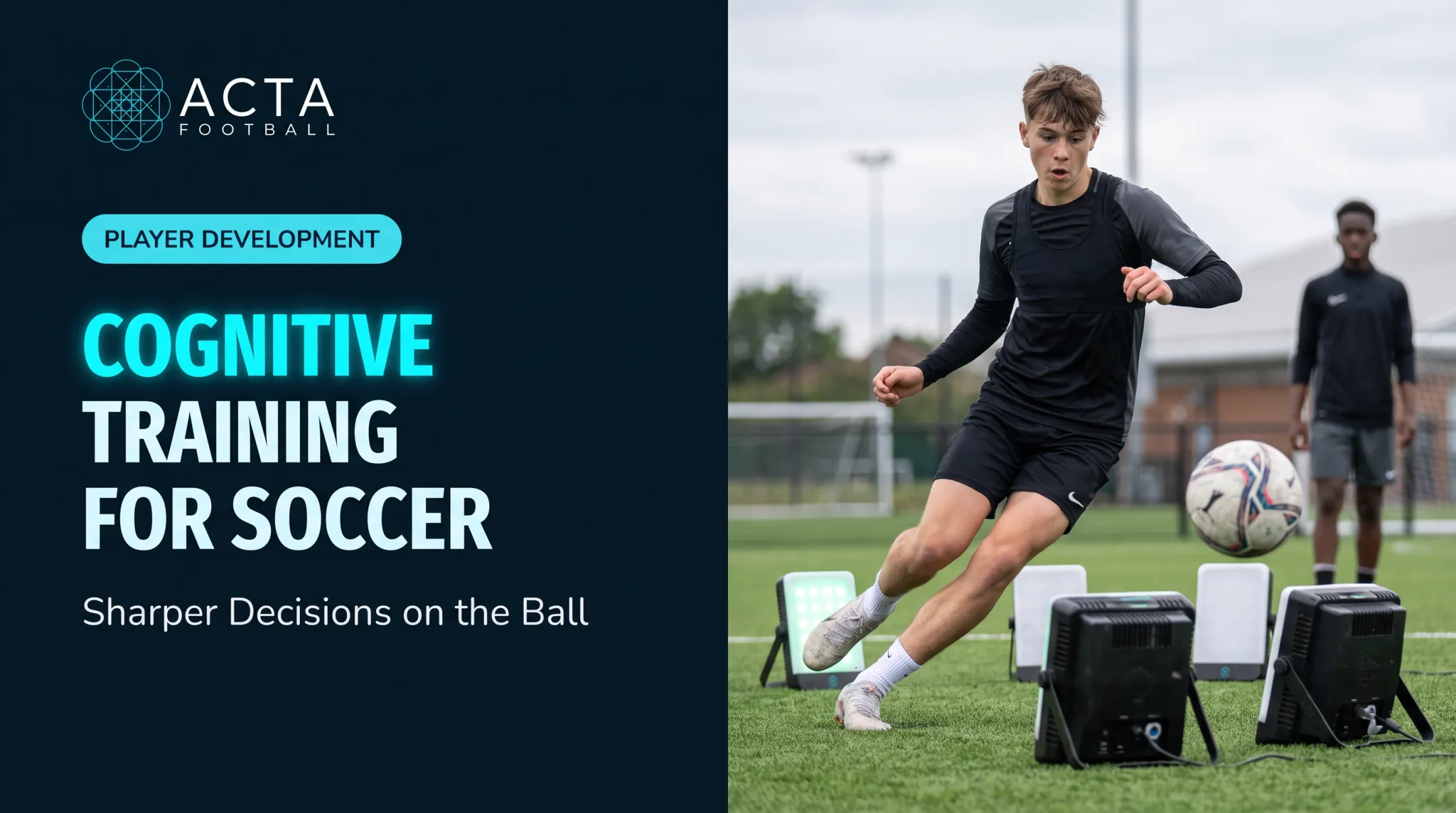
Solo scanning drills build the raw material for game intelligence. The next step is pairing that habit with real decision speed.
ACTA Football frames that as cognitive speed (processing the field, reading defenders, anticipating what comes next) plus executive speed (executing the right choice under pressure). Players who need feedback tied to their own match film often use ACTA's one-to-one game-speed training: score real footage, isolate one bottleneck, coach the fix, then re-score to show measurable change.
How to Choose the Right Drills
The right drill depends on the player's development goal and match needs, not popularity or how flashy the move looks online.
Player Objective and Position
- Defenders: receiving under pressure and clean passing angles
- Midfielders: scanning, body orientation, and first-touch speed
- Attackers: 1v1 movement and finishing from multiple angles
- All players: both-foot competence, no exceptions

Current Skill Level and Progression
Start with a technically controlled version of any drill. Increase speed, shrink the space, add weaker-foot demands, or raise decision complexity only once execution stays reliable at the easier level.
Rushing progression locks in sloppy technique at a faster pace.
Space, Equipment, and Safety
Pick the setting based on what's available:
| Setting | Best For | Watch For |
|---|---|---|
| Indoor space | Ball mastery, juggling | Low ceilings, breakables |
| Driveway or yard with cones | Dribbling, turns | Uneven surfaces, traffic |
| Wall or rebounder | Passing, first touch | Nearby windows, people |
| Field with a goal | Finishing, movement | Weather, ball retrieval path |
Time and Training Load
A short solo session can follow a simple structure:
- Warm-up
- Two or three priority skills
- One game-like progression
- Cooldown
Balance solo work with team sessions, matches, school, and recovery. Extra solo time still counts toward total training load.
Feedback and Measurement
Track something concrete: video review, target-hit percentage, first-touch quality, weak-foot usage, or whether the skill actually showed up in a recent game. When progress feels unclear, objective feedback helps. ACTA Football's individualized coaching and match-film analysis give players a specific read instead of a guess.
What to Check Before Finalizing a Routine
These checks keep a solo routine useful instead of turning into wasted repetitions:
- Don't jump to advanced drills if the basic movement isn't happening with balance and control yet
- Measure more than speed: accuracy, decision quality, and weak-foot confidence matter just as much as how fast a move looks
- Rotate skill categories instead of repeating the same comfortable drills every session
- Watch for warning signs: persistent pain, unsafe surfaces, or fatigue that breaks down technique are reasons to stop, not push through
The American Academy of Pediatrics recommends at least one rest day per week from organized sport and increasing training load by no more than 10–20% at a time to avoid overuse injuries. A solo session added on top of team training still counts toward that total load.
Before locking in a routine, confirm it includes:
- A clear purpose for each drill
- A simple way to measure progress
- A built-in progression path
- A plan to check whether the work is transferring into games
Conclusion
Solo soccer training works best when it's purposeful, technically sound, and tied to real match actions rather than volume for its own sake. Players can build ball mastery, dribbling, first touch, passing, finishing, and game awareness with a ball, some cones, and a well-designed routine.
Start with one or two priorities and track quality over quantity. When progress plateaus, seek qualified feedback for a more individualized path forward.
Frequently Asked Questions
How does the 80/20 rule apply to soccer?
Players get the most from solo sessions by focusing on the few weaknesses that most affect match performance, while still keeping broader skills sharp. There's no validated formula: it's a prioritization mindset, not a strict ratio.
What are the best solo soccer training drills for beginners?
Start with simple ball mastery, juggling, cone dribbling, wall passing, first-touch, and target-shooting drills. Keep progressions controlled and only add speed or complexity once the basic movement feels reliable.
Can you improve at soccer by training alone?
Yes. Solo work builds technique, coordination, and confidence. But players still need team practice and live opponents to develop communication, pressure tolerance, and game awareness that solo drills can't fully replicate.
How often should I do solo soccer training?
There's no single schedule that fits every player. Base frequency on age, current team training load, matches, and recovery needs, and adjust when technique or energy starts to slip.
What equipment do I need for solo soccer drills?
A ball, proper footwear, cones or household markers, and a safe wall or rebounder cover most drills. Water and a phone for video review or reaction cues are useful extras, not requirements.