
But one always seems to know where the ball is going before it gets there. She's already turned her hips, already scanned the space behind her, already made the pass before the defender closes in. The other player? Always half a step late, always reacting instead of anticipating.
That gap isn't talent. It's Football IQ, and it's trainable.
Football IQ covers pattern recognition, anticipation, and decision-making under pressure. This guide breaks down what it is, why most training misses it, which drills actually build it, and how ACTA Football's cognitive-based coaching develops it systematically.
Key Takeaways
- Football IQ is pattern recognition, anticipation, decision speed, and confidence under pressure—working together in real time
- Drill-heavy practices build technique but skip the "why" behind each decision
- Film study, small-sided games, and reflective questioning sharpen game sense beyond drill volume alone
- Individualized, game-speed coaching builds faster decisions than generic group training
What Is Football IQ and Why It Matters
Football IQ is the mental ability to read patterns, anticipate what happens next, and choose the right action fast. It separates players who only react after the play starts from players who read the game before it unfolds.
A study of youth players wearing eye-tracking equipment found that faster decision-makers used fewer, more efficient fixations and reported more planning-oriented thought processes—not just quicker reflexes (Cardoso et al., 2021).
Elite game sense comes from smarter information gathering, not faster muscles alone.
This matters more as players move up the competitive ladder:
- ECNL, MLS Next, and Premier-level players are increasingly similar in physical ability
- Football IQ becomes the differentiator between players who get selected and those who don't
- German youth-national-team research found future national-team players scored higher on build-up decision tests than peers who didn’t make the cut
Football IQ isn't position-specific, either:
- Defenders read danger before it materializes
- Midfielders control tempo by recognizing when to speed up or slow down
- Attackers anticipate space that hasn't opened yet
Every position needs it—the reads change, the advantage does not.

Why Traditional Training Falls Short on Game Sense
Most practice sessions teach the "how" of a skill: how to strike a ball, how to control a first touch. Few teach the "when" or "why." That leaves players technically sharp but tactically reactive.
Traditional sessions fall short in a few predictable ways:
- Large group drills put 16 players on the same passing pattern, leaving little room for individualized decision-making feedback
- Coaches can fix a poor first touch in real time, but a poor read of the game needs one-on-one attention group settings rarely allow
- Game sense is treated as something that arrives with age and reps, yet it does not develop automatically
One observational study of youth coaches found no meaningful difference in on-ball decisions per minute between regular training and sessions designed to build decision-making (O'Connor et al., 2017).
Those sessions were often too stop-start, and coaches unintentionally did the thinking for the players. Without intentional coaching, game sense stalls, no matter how many seasons a player logs.
Core Methods to Train Football IQ
Cognitive and Reaction-Based Drills
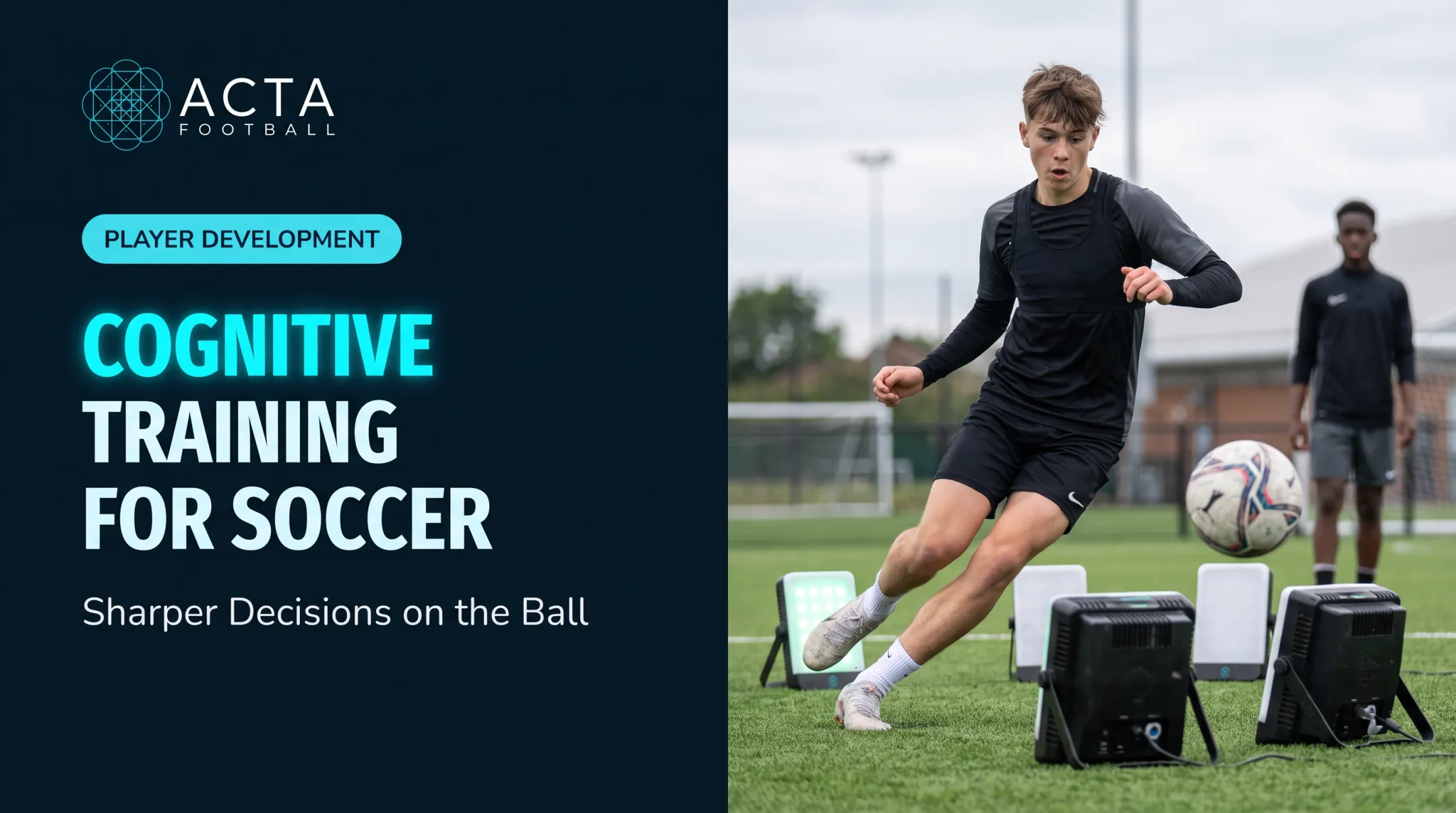
Reaction training connects what a player sees with the next action. ACTA's camps use Variable Reaction Training for exactly this purpose: sharpening the link between visual recognition and speed of execution.
Small-sided games (3v3, 4v4) are ideal supplements because they force constant decisions:
- More touches per player than 11v11 formats
- Compressed space demands faster reads
- Fewer teammates means every player is directly involved in build-up and defense
One study found that format changes matter: a 3v3 goal-scoring setup produced higher decision-making success than a possession-only format (Fernandez-Espinola et al., 2020). The takeaway: design the game with a clear objective, not just space and numbers.

Once players are making faster on-field reads, film study helps them recognize the patterns behind those decisions.
Film Study and Pattern Recognition
Watching match footage—either the player's own or professional games—builds pattern recognition over time. The method:
- Pause before key moments and predict what happens next
- Compare the prediction to the actual outcome
- Identify the cue that should have signaled the right read
ACTA starts by scoring a player's match film to pinpoint where decisions break down, then runs personalized film sessions to rewire that pattern. The film is re-scored afterward to confirm the change, not just assume it.

Those cleaner reads still have to hold up when space disappears. That is where rondos and positional play come in.
Rondos and Positional Play Exercises
Rondos build quick thinking under pressure by forcing tight spatial decisions with defenders closing in. They work at every level, but complexity should rise with age and ability:
- Younger or newer players: simple keep-away concepts, fewer defenders, larger space
- Older or advanced players: tactical wrinkles like pressing triggers, defensive shape, and transition rules
FIFA's Training Centre uses transitional rondos with neutral players specifically to force decisions about when to slow down, speed up, or play forward under real opposition (FIFA Training Centre, 2024). The opposition is what makes it work. Unopposed passing drills don't build the same decision-making muscle.
Building Confidence and Mental Flexibility Under Pressure
Recognizing the right decision isn't enough. Players need the confidence to execute it, especially with a defender closing fast or a crowd watching.
A study of academy players found that adding cognitive-behavioral workshops and reflective diaries to pressure training significantly improved decision-making scores compared to pressure training alone (Kent et al., 2022). Reflection paired with pressure beats pressure alone.
Environment matters just as much as drills. A punitive coach who berates every misplaced pass teaches players to avoid risk. A supportive one who allows for mistakes lets players experiment, which is how decision-making actually improves.
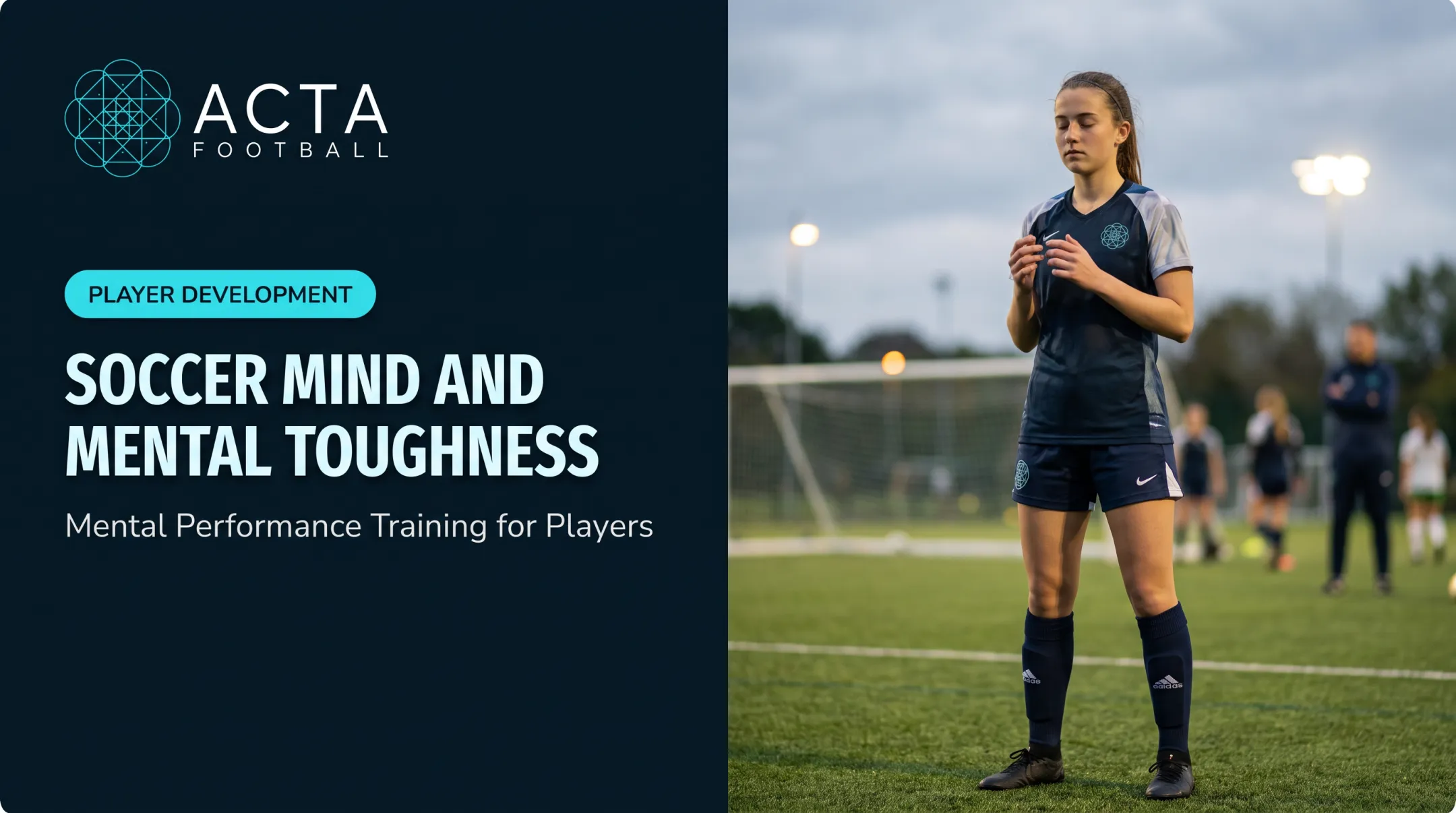
ACTA's approach combines cognitive speed with executive speed (processing plus execution), alongside a confidence accelerator program. Mental training can help players improve nearly twice as fast with nearly 50% less pre-game anxiety. That confidence work runs as a six-module online course covering topics such as:
- The neuroscience behind why players shut down under pressure
- A repeatable pre-game mental routine
- The "3-Second Reset" to interrupt negative spirals after mistakes
The Parent's Role in Developing Game Sense at Home
Watching games together doesn't have to be passive. A few adjustments turn it into active training:
Turn watch-time into think-time. Ask prediction questions during the match: "Where do you think that pass goes next?" or "What's the defender's next move?" These prediction questions train the same tactical decision-making skills players need on the field.
Focus post-game talks on decisions, not outcomes. Instead of "Why didn't you score?" try:
- "What did you notice in that moment?"
- "What options did you see?"
- "What made you choose that one?"
Resist constant sideline instructions. A 2021 study of youth soccer players found they wanted less parental direction and pressure, and more praise and understanding (Youth Soccer Parental Involvement Study, 2021). Kids need space to make their own in-game calls, even the wrong ones, to build real game sense.
How ACTA Football Builds Measurable Game Sense
ACTA's flagship program, ACTA One, builds Football IQ around each player's own match film rather than generic group drills. The process:
- Score the film to find the exact decision-making bottleneck
- Run personalized one-to-one sessions with specific recommendations
- Re-score the film to confirm real, measurable change
Training takes roughly one hour per week online. Sessions pair with Action Lab AI, which generates machine-measured scores including:
- ACTA Action Success — how often a player's actions succeed
- Disruption Score — a player's disruptive impact during play
- Progression Score — contribution to advancing play forward

ACTA backs the system with evidence rather than a promise: players are scored on their own game film before and after training, so any change in reading speed is recorded.
The coaching team includes USSF "A" and UEFA "B" licensed staff. Founder Garrett Morgan has helped develop more than 30 youth national team players across six countries.
Frequently Asked Questions
How do I improve my Football IQ?
Build it through a repeated cycle of watching, predicting, and reviewing decisions. Pair game film study, small-sided reps, reflective questioning, and consistent feedback—no single drill does it alone.
Does playing more matches improve Football IQ?
Match experience helps, but only when paired with reflection. Games without reviewing the decisions you made won’t sharpen game intelligence by themselves.
Is Football IQ more important than physical ability?
Both matter, but higher Football IQ often lets players outperform faster or stronger opponents simply by making better decisions with less time and space.
Do all positions require the same level of Football IQ?
Every position needs it, but the application differs. Defenders read danger, midfielders control tempo, and forwards anticipate space that hasn't opened yet.
Can Football IQ really be taught, or is it innate?
It can be trained. Guided reflection, game-awareness exercises, and intentional coaching build it over time, regardless of natural starting point.
How long does it take to see improvement in game sense?
Measurable gains in decision speed can appear within weeks of focused training. Full mastery, however, develops over multiple seasons of consistent, deliberate work.