
Quick clarification before we start: "football" here means soccer, the sport played with a ball and two goals. This guide is written for youth players, parents, and coaches across the US who want a practical, age-appropriate approach to training.
We'll cover program foundations, drills that actually transfer to matches, how to adapt training by age and safety needs, weekly scheduling, and how to track progress that matters.
Key Takeaways
- Build the full player: technical skill, game intelligence, movement quality, confidence, and recovery.
- Design drills that force perception and decisions under pressure, not isolated reps.
- Match space, rules, and complexity to age, experience, and physical development.
- Measure first-touch quality, scanning, and decision speed—not how many reps you completed.
Build the Foundations of an Effective Youth Football Training Program
Before picking a single drill, define what you're actually trying to develop. Most youth programs should target:
- Ball mastery and close control
- Receiving and passing under pressure
- Dribbling and 1v1 ability
- Scanning and decision-making
- Movement quality and confidence
Why Game-Like Repetition Beats Lines and Cones
Standing in line waiting for a turn wastes the touches and decisions players need on game day. U.S. Soccer's Play-Practice-Play model recommends structuring sessions as play, then game-like practice, then a bigger scrimmage with minimal interruption. Every technical activity should connect to a real game problem: opposition, a directional target, or a changing condition.

This is part of why ACTA Football keeps its camp segments small, roughly one coach for every 3.5 players, instead of running large groups through the same repetitive drill. Smaller groups mean more decisions, more touches, and more targeted feedback per player.
A Simple Session Flow
- Dynamic warm-up – movement prep, no static stretching
- Technical activation – short ball-mastery work
- Focused skill practice – passing, receiving, or 1v1 patterns
- Opposed or decision-based activity – add pressure and choices
- Small-sided game – apply everything live
- Cool-down or reflection – brief, honest feedback
Progressing an Activity
Change one variable at a time:
- Reduce the space
- Add a defender
- Limit touches
- Increase scanning demands
- Require a specific transition after winning or losing the ball
Keep Equipment Simple
Once the activity design is clear, keep the kit simple. Equipment doesn't need to be fancy. A handful of balls, cones, bibs, and a couple of small goals covers most sessions. Agility ladders and hurdles are optional extras. Purposeful coaching beats a garage full of gear every time.
Youth Football Drills That Transfer to Match Performance
These six drills build skills players actually use in games, not just on a training field.
| Drill | Setup & Objective | Coaching Cues | Age/Length | Progressions |
|---|---|---|---|---|
| Ball mastery circuit | Toe taps, inside-outside touches, sole rolls, pullbacks in a small marked space | Head up, use both feet, keep touches close | Ages 6+, 8-10 min | Easier: stationary, no time pressure. Harder: react to a coach's cue |
| Passing through gates | Two-cone gates as target routes; receive, check shoulder, pass, move | Scan before receiving, weight the pass, receive away from pressure | Ages 8+, 10-15 min | Easier: stationary partner passing. Harder: add a passive then active defender |
| Color/number reaction | Cones placed around the player, each assigned a color or number; coach calls the target | Find the free option, react fast, don't guess | Ages 8+, 8-12 min | Easier: one player, one called target. Harder: 3v3 with a shot clock |
| 1v1 attacking/defending channel | Attacker has a direction or goal; defender presses immediately | Attacker: change speed, protect the ball. Defender: stay patient, force a mistake | Ages 9+, 10-15 min | Easier: passive defender, wider channel. Harder: add a second defender for a 2v1 |
| Rondo/possession game | Small group keeps the ball against a few defenders in a tight space | Support beyond the press, receive on the back foot, combine quickly | Ages 9+, 10-15 min | Easier: more space, no touch limit. Harder: one-touch only for central players |
| Small-sided transition game | Small teams attack one goal, then react the instant the ball changes hands | Scan for space immediately, recover defensively fast | Ages 9+, 12-20 min | Easier: no offside, added neutral zones. Harder: apply offside rules |
ACTA's camp curriculum follows the same idea with Variable Reaction Training, linking what a player sees to the next action instead of a pre-set response. The ball, not the whistle, decides what happens next.
Adapt Training by Age, Ability, and Safety Needs
A drill that works for a 16-year-old academy player can backfire on a 7-year-old, and vice versa. US Youth Soccer's player development framework breaks development into stages, and each one calls for a different emphasis.
Matching Complexity to Stage
- Younger beginners (roughly 5-8): Prioritize fun, coordination, and ball familiarity with frequent touches over technical precision.
- Developing players (roughly 9-12): Introduce directional play, receiving on the move, and basic decision-making under light pressure.
- Competitive and elite players (13+): Increase speed of play, shrink the available time and space, and demand quality decisions even after fatigue sets in.
Safety Fundamentals That Shouldn't Be Optional
- Warm up properly before adding speed or contact
- Teach movement quality before volume
- Supervise all strength and agility work
- Build in hydration breaks and real recovery time
- Stop the activity when technique starts to break down
- Get qualified medical guidance for any pain or injury concern
The American Academy of Pediatrics recommends at least one to two days away from sport-specific training each week and a two-to-three month seasonal break from each sport a young athlete plays. That guidance holds regardless of how talented the player is.

ACTA builds this thinking into its small-group coaching model, including the five-day girls residency program, where close coach-to-player ratios help catch fatigue before it becomes an injury.
How to Organize a Weekly Youth Football Training Program
There's no single correct schedule. Frequency and duration depend on age, competition load, school demands, and how many other sports a player is juggling.
A flexible starting template looks like this:
| Day | Focus |
|---|---|
| High-intensity day | Opposed passing, 1v1 work, or a transition game |
| Light day | Ball mastery, easy passing, mobility |
| Rest day | Away from organized soccer entirely |
| High-intensity day | Rondo or possession play plus a small-sided game |
| Light day | Brief technical touches, no added conditioning |
| Match day | Competition |
| Recovery day | Unstructured play only if the player feels ready |
Pick one weekly emphasis—first touch and passing, 1v1 play, finishing, or game intelligence—while still touching on core skills every session.
A 60-90 minute coach-led practice might look like this:
- 10 minutes of warm-up
- 20 minutes of technical work
- 20 minutes of an opposed activity
- 20-30 minutes of small-sided games
Build recovery in between demanding blocks.
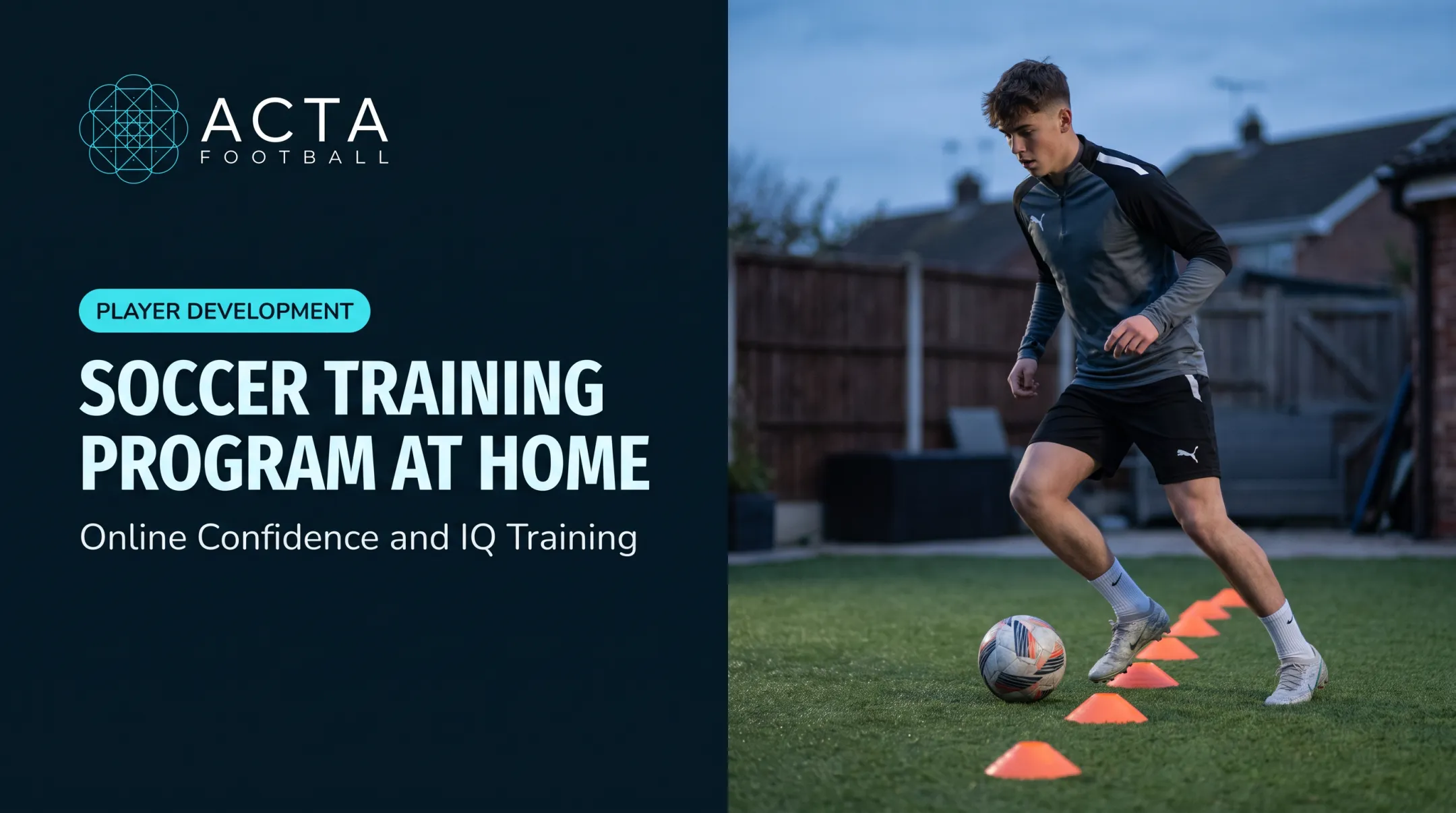
ACTA's online coaching model requires only about 45-60 minutes per week from home. It is designed to sit alongside a player's existing club and school commitments rather than replace them.
How to Measure Progress and Personalize Development
Counting reps tells you almost nothing about whether a player is actually improving. What matters is what shows up in games:
- First-touch quality under pressure
- Successful passes when an opponent is closing in
- Effective scans before receiving the ball
- Useful movement off the ball
- 1v1 outcomes, both attacking and defending
- Speed and accuracy of decisions
Simple tools help track those game moments:
- Baseline observation
- Coach's notes
- Honest player reflection
- Occasional video review
Pick one or two priority areas at a time. Overloading a young player with ten corrections at once rarely sticks.
This is where individualized, film-based coaching earns its keep. ACTA Football's one-to-one training uses a player's own match footage to identify a specific decision-making bottleneck, then re-scores that same footage later to show measurable change.

Through its partnership with Action Lab AI, ACTA also provides machine-measured scores and an evaluation report that pinpoints what's holding a player back on the field.
If you're a parent trying to figure out where your player's development should focus next, a short conversation with a coach who can watch actual match film is often more useful than another season of generic drills. ACTA's free player development session is a straightforward way to get that kind of objective read before committing to a program.
Frequently Asked Questions
What is the best age to start football training?
Most kids can start informal play and basic skills around ages 4–6. Structured training should follow coordination, focus, and enjoyment—not a fixed birthday.
What is a good training program for football?
A strong program blends ball mastery, passing, dribbling, 1v1 work, scanning, and decision-making inside small-sided games. Age-appropriate coaching and real recovery time matter as much as the drills.
How often should youth football players train?
Frequency depends on age, match load, school, and other sports. Follow a qualified coach’s plan instead of copying an older or more advanced player’s schedule.
What drills improve decision-making in youth football?
Rondos, reaction games, opposed 1v1s, and small-sided transition games force faster choices. Players must scan early and pick pass, dribble, or movement under pressure.
How can parents support football training at home?
Keep home sessions short and fun, give kids a safe space to play, and set realistic goals. Encourage without over-coaching—rest matters as much as reps.