
Introduction
Your kid just finished a two-hour team practice. Now what?
Many competitive parents grab a bag of cones and run through the same dribbling drills from last week, hoping something sticks. That's not a plan. That's guessing.
Extra training only helps when it connects to how the player actually performs in matches. Without a clear objective, solo sessions become repetitive ball-touch work disconnected from the split-second decisions players face on the field.
A real individual soccer training program blends technical repetition with game-speed decision-making, tactical awareness, and confidence under pressure.
This guide covers what a strong session includes, how to personalize a plan for your player, where solo work differs from individualized coaching, and how to evaluate a program before you commit.
Key Takeaways
- Individual training should supplement team practice, not compete with it or drain recovery time
- Give every session one clear objective instead of a mixed bag of unrelated drills
- Strong programs tie drills to match film, position demands, and recurring in-game patterns
- Real coaching pairs drill work with feedback and measurable progress tracking
What Should an Individual Soccer Training Program Include?
A well-built session has a rhythm: prepare, repeat, apply, reflect. Skip any piece and you either waste time or train skills that never show up in a match.
The Core Building Blocks
Most effective sessions rotate through these elements:
- Dynamic warm-up to activate the body and mind before ball work begins
- Ball mastery for touch, feel, and comfort under both feet
- First touch and passing under increasing pressure and distance
- Dribbling and turning with realistic angles and defenders in mind
- Finishing or position-specific actions tied to the player's actual role
- Cognitive decision-making that forces a choice, not just a movement
- Cool-down and recovery to close the loop
Why Progression Matters More Than Repetition Alone
Cone drills build comfort. They don't build game readiness on their own. U.S. Soccer's coaching guidance points out that soccer requires constant scanning and problem-solving under variable conditions. Activities with real choices and unpredictability build autonomy far better than fixed, prescriptive drills.
That means technical work should progress:
- Controlled repetition — clean mechanics, no pressure
- Speed and direction changes — same skill, faster tempo
- Added pressure — a defender, a shadow, a clock
- Game-realistic choice — scan, decide, execute

Physical Work Shouldn't Duplicate the Team's Load
Even a clean technical progression falls apart if the player is already cooked from team training. Conditioning inside an individual session should sharpen soccer-specific qualities, not pile on generic cardio. Age, weekly schedule, current fitness, and injury history should all shape how much physical work gets added. A tired 13-year-old with two team sessions already logged that week needs a lighter technical focus, not more running.
A Sample Flow (Adapt, Don't Copy)
- 8-10 minutes: dynamic warm-up with the ball
- 15 minutes: technical block (both feet, multiple surfaces)
- 15 minutes: game-speed application with decisions and role-specific actions (wall, rebounder, or partner)
- 5 minutes: cool-down and reflection
Close every session with a quick review: what improved, what broke down under speed, and what to revisit next time.
How to Build an Effective Individual Soccer Training Session
Structure beats volume. A focused 40-minute session with one clear goal will outperform a 90-minute session with five.
Start With a Specific "Why"
Before touching a ball, define one outcome. Examples:
- Improve the first touch away from pressure
- Receive the ball on the half-turn consistently
- Beat a defender 1v1 on the outside
- Finish cleanly after a specific movement pattern
Everything in the session should serve that single goal.
Preparation Comes Before Technique
The warm-up isn't just physical. Use light ball touches and simple movement patterns that mirror the session goal so attention switches on with the body. Ten focused minutes beat twenty of generic stretching.
Build the Technical Block With Intention
Repetition should be deliberate:
- Use both feet and multiple surfaces (inside, outside, laces, sole)
- Vary speed, direction, distance, and angle on every set
- Avoid mindless repetition without a defined target
Add a Game-Speed Application Block
This is where technique becomes soccer. Use a wall, rebounder, training partner, coach, or small goal to force a decision. The player must scan, choose an action, and execute — not just repeat a movement on autopilot.
That decision loop is the core of ACTA Football's individual work. Game Speed Diagnosis scores a player's real match film, isolates the bottleneck slowing the action down, then re-scores the same moment after training so progress is measurable—not guessed.

Manage Rest and Intensity
High-quality reps need real recovery. Keep intensity honest with a simple rule set:
- Rest enough between sets that the next rep still looks clean
- Stop the block if fatigue turns technique into survival
- Use short breaks between blocks to reset focus, not scroll a phone
Finish With a Training Log
Record four things after every session:
- The objective
- Exercises completed
- Perceived difficulty and successful actions
- One focus area for next time
How to Personalize the Program Around the Player and the Game
Generic drills help everyone a little. Personalized training helps one specific player a lot.
Establish a Real Baseline
Start by reviewing:
- Recent match footage
- Coach feedback from team sessions
- Position-specific responsibilities
- Player self-assessment of strengths and weaknesses
Organize Goals Into Categories — Then Prioritize
Sort development needs into technical, cognitive, tactical, physical, and confidence buckets. Then pick one or two priorities, not all five at once. Trying to fix everything in every session usually means fixing nothing well. Position shapes the priority:
| Position | Common Focus Area |
|---|---|
| Midfielder | Receiving under pressure |
| Outside back | Progressing the ball forward |
| Winger | Attacking 1v1 |
| Forward | Creating a finishing opportunity |
| Goalkeeper | Distributing under pressure |

Turn Match Observations Into Training Tasks
If film shows a recurring missed scan before receiving the ball, build a constrained drill around that exact moment — not a generic passing pattern. The task should have a measurable decision or execution target tied to what actually happened in a game.
Follow a Progression Model
- Learn the movement in isolation
- Perform it at speed
- Select it correctly under pressure
- Apply it consistently across real matches This progression is the backbone of ACTA Football's one-to-one, game-speed approach. Sessions are built from a player's own match film so training targets real decision bottlenecks, then the same actions are re-checked after focused work. A 2021 meta-analysis on youth team-sport players found structured tactical-decision training improved tactical behavior versus control groups—one reason film-based, decision-focused work belongs in a personalized plan.
How Often Should Players Train Individually?
There's no universal number here. Frequency depends on age, competitive level, school and team schedule, match minutes, and how much intensity the player is already absorbing elsewhere.
Balance, Not Addition
Individual sessions should fit around team commitments, not stack on top of them without adjustment. The American Academy of Pediatrics recommends one to two days off per week from a young athlete's primary sport to reduce injury risk, plus extended breaks across the year.
Practical guardrails:
- Reduce volume when the player is fatigued, sore, or in pain
- Count individual sessions as part of total weekly load, not separate from it
- Prioritize recovery days as non-negotiable, not optional
Consistency Beats Marathon Sessions
One focused 45-minute session done consistently each week builds more skill than an occasional two-hour blowout. ACTA Football's own model reflects this: its structured methodology runs on roughly 45-60 minutes per week, delivered online, without adding extra drives or extra practices to an already full schedule.
Keep the weekly touchpoint short, track total load with team training, and protect recovery days so consistency stays sustainable.
How to Choose a Good Individual Soccer Training Program
Not every training format fits every player. Match the format to your goals, budget, and need for feedback before you commit time or money.
Comparing the Formats
| Format | Strength | Limitation |
|---|---|---|
| Solo practice | Free, flexible, builds touch | No feedback or pressure |
| Self-paced online | Structured, low cost | Limited personalization |
| Live small-group | Some individual attention | Shared coach time |
| One-to-one coaching | Fully personalized | Higher cost, scheduling demands |
| Blended programs | Structure plus personal feedback | Higher player commitment |

A Quality Checklist
Look for:
- Qualified, credentialed coaches
- Age and competitive-level fit
- Real personalization, not templated drills
- Clear link to real game situations
- A defined progression model
- Individualized feedback loops
- Awareness of total training workload
- Safety protocols and injury-history screening
- A concrete way to track improvement over time
Decision-Making Matters as Much as Technique
A program that only teaches isolated skills misses half the job. Players also need to read the game and choose the right action under pressure. At competitive levels, standing out in matches—not just in practice—is the real goal.
When you compare options, weigh coaching credentials, personalization, and game-speed decision training—not drill volume alone. ACTA Football’s blended model is built around that mix: USSF “A” and UEFA “B” licensed coaches, self-paced modules, live one-to-one sessions, film review, and tactical game-reading work.
No program delivers identical results for every athlete. Workload, consistency, and starting point still decide how far a player goes.
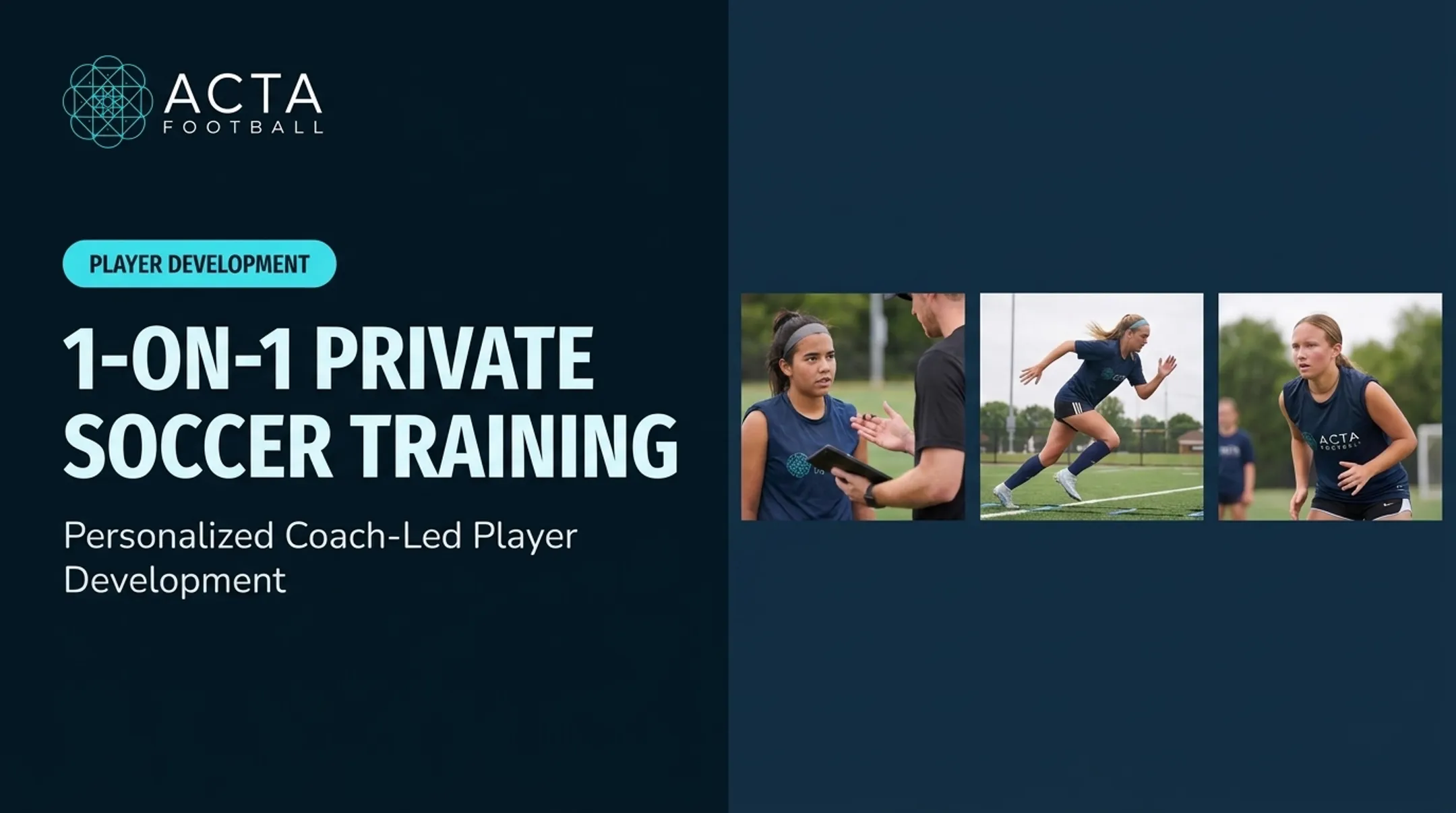
Is Private or One-to-One Soccer Training Worth It?
Sometimes. It depends entirely on what the player actually needs.
When One-to-One Coaching Pays Off
Private coaching tends to add real value when:
- A player has a specific, recurring weakness that team practice doesn't address
- The player needs position-specific guidance no one else is giving them
- There's no objective feedback loop currently in place
- The player is preparing to step up to a higher competitive level
Private Coaching vs. Solo Training
| Factor | Solo Training | One-to-One Coaching |
|---|---|---|
| Accountability | Self-driven | External and structured |
| Correction | None built in | Immediate and specific |
| Adaptation | Static | Adjusts session to session |
| Decision-making context | Limited | Built into game-speed drills |
| Cost | Free | Ongoing investment |

Private coaching isn't automatically the better choice for every goal or every budget. A disciplined player with clear objectives can improve plenty on their own.
How to Judge Value Beyond the Price Tag
Before signing up, ask:
- What are the coach's actual qualifications?
- Does the coach prepare specifically for each session?
- Is there an individual assessment before training starts?
- Is feedback provided between sessions, not just during them?
- Does the training show measurable transfer to match performance?
How a coach answers those questions usually reveals the real difference between programs. Many private sessions still emphasize footwork alone. ACTA Football builds one-to-one work around the player's own match film so training targets decisions at game speed, not only technique.
Rates vary by coach experience, session format, delivery method, and whether analysis is included. Request current pricing from any provider rather than relying on a rough estimate.
Conclusion
The strongest individual soccer training programs share four traits: they're purposeful, progressive, game-relevant, and coordinated with everything else the player is already doing. Random drilling doesn't build that. A plan does.
Start with one clearly defined objective. Track how it changes over weeks, not days. Adjust as match demands shift.
If you're looking for individualized, cognitive, and technical development built around your player's own game film, explore ACTA Football's training options or reach out at support@actafootball.com.
Frequently Asked Questions
How much does one-to-one soccer coaching cost?
Rates vary by coach experience, session format, delivery method, session length, and whether match-film analysis is included. Ask the coach or program for current rates instead of relying on a general estimate.
What should a soccer training session include?
It should open with a goal-led warm-up, then move into focused technical work, game-speed application, and decision-making practice. Build in rest between blocks and close with a brief review or cool-down.
What is a good training program for soccer players?
A progressive, individualized program that's game-relevant, age-appropriate, compatible with team training demands, and backed by feedback and measurable progress tracking.
Is private soccer training worth it?
It adds real value through personalized assessment, correction, accountability, and position-specific work. Whether it's the right choice still depends on the player's goals, schedule, and budget.
How often should a soccer player train individually?
Frequency should reflect age, current workload, match schedule, and recovery needs. Prioritize consistent, quality sessions over occasional marathon workouts, and consult a qualified coach when planning volume.
Can soccer players improve by training on their own?
Yes — structured, consistent solo practice builds technical foundations and confidence. However, partners, coaches, or match-based constraints are still needed to develop realistic pressure and decision-making skills.