
Many parents and players search for coaching that improves in-game decision-making, not just drills. They want fewer touches that look good in isolation and more moments where their kid actually reads the play correctly under pressure.
Research backs this concern up. A systematic review of youth team-sport players found that high-level athletes weren't just technically sharper. They were significantly better at adapting to tactical context and reading the game than their lower-level peers.
This guide covers what player-focused coaching actually involves, the core skills coaches target, program formats, realistic costs, and how to pick the right coach for your player's level.
Key Takeaways
- Player-centered coaching integrates technical, tactical, physical, and cognitive work—not isolated drills alone
- Game-speed, film-based training identifies decision-making bottlenecks faster than generic group sessions
- Costs range from $139–$425 for camps to $799+ for structured multi-week programs
- USSF/UEFA credentials plus a documented development record separate serious programs from hype
What Does Football Coaching for Players Really Involve
Team-results coaching cares about the scoreboard. Player-centered coaching cares about whether an individual athlete is getting measurably better at reading, deciding, and executing.
U.S. Soccer's own coaching model backs this framing directly, stating that session planning should start with the individual player's needs, matched to their developmental stage.
The Four Pillars
Good player development touches four connected areas:
- Technical — ball control, passing, shooting execution under match conditions
- Tactical — positioning, spacing, reading opponents, decision speed
- Physical — speed, agility, conditioning suited to position and age
- Mental/cognitive — attention, anticipation, composure under pressure
None of these work in isolation. A player can have great footwork and still freeze if they can't process the play fast enough to use it.
Why Cognitive Training Changes the Timeline
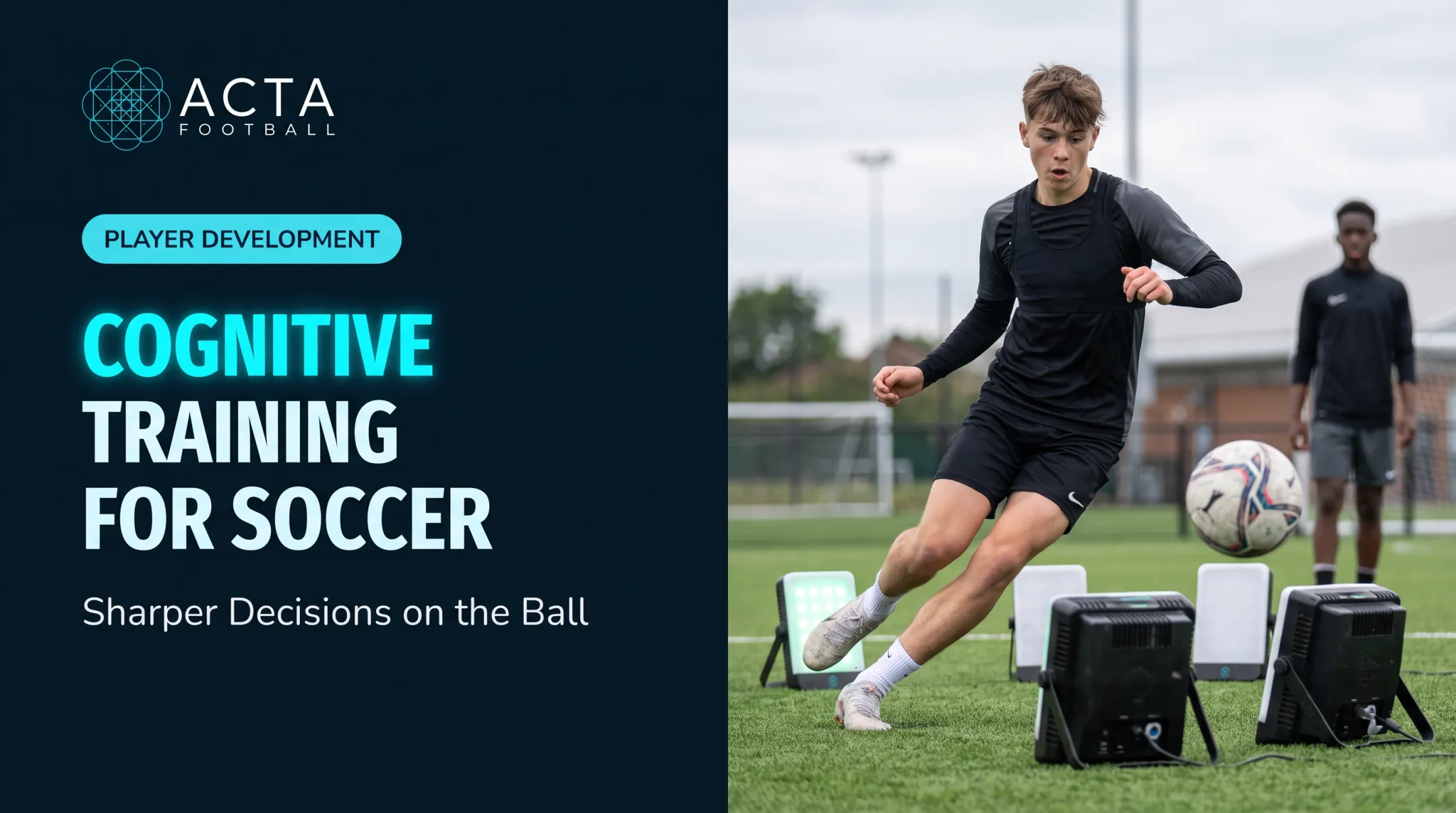
This is where a lot of traditional coaching falls short. Field reps build technique, but they don't always build game speed: the ability to read a situation and execute a decision before the window closes.
ACTA Football's internal data shows players who add cognitive training improve up to 30% faster than players who train only on the field. Those same players report nearly 50% less anxiety before and during games. That's a meaningful gap for a family deciding where to invest training time.
Objective Feedback Beats Generic Praise
"Good job" doesn't tell a player what to fix. Video and data-based evaluation does.
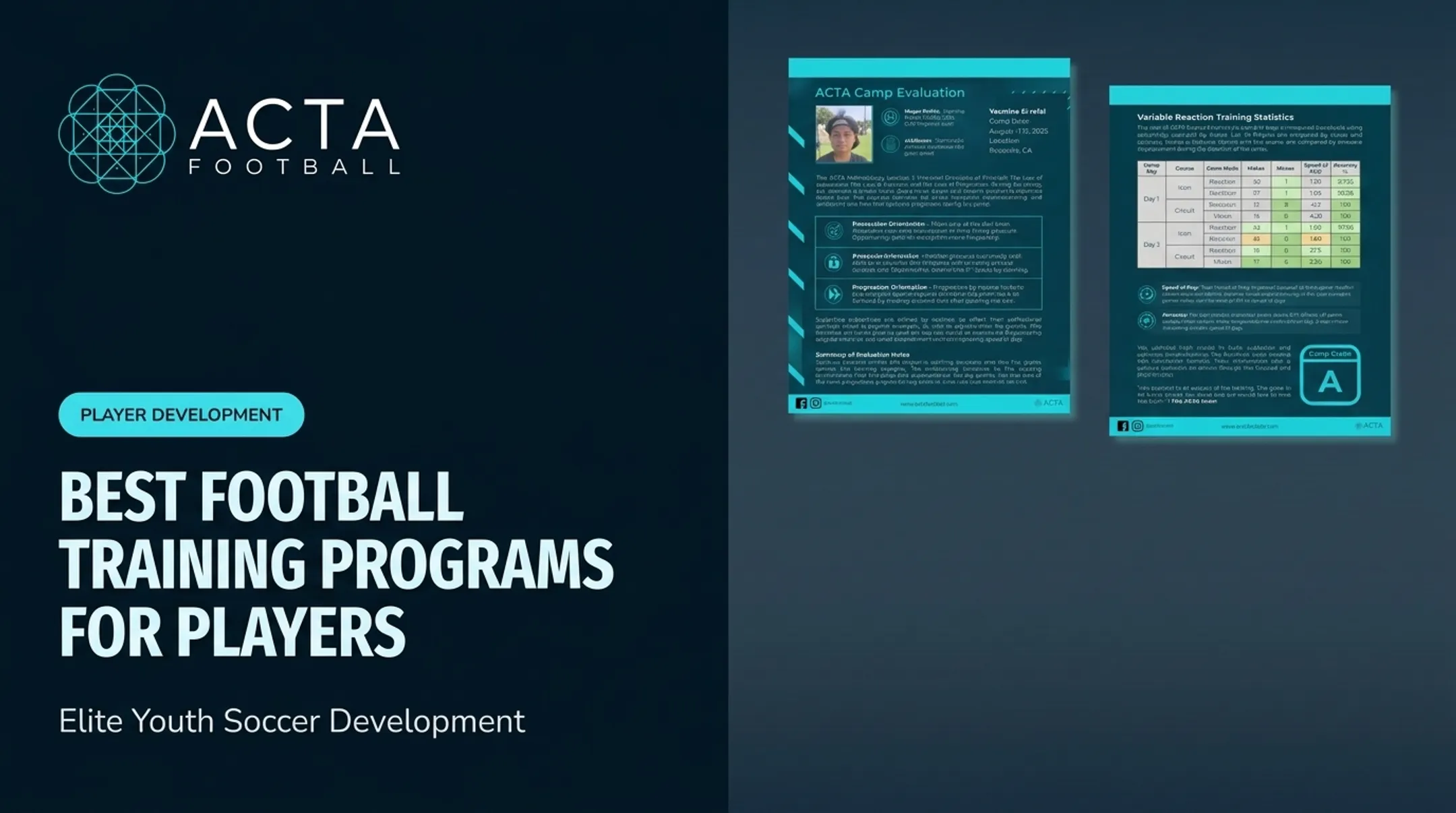
ACTA's Action Lab AI partnership provides machine-measured speed-of-play and accuracy scores alongside coach feedback, the same category of tools used by professional academies.
ACTA's Game Speed Intelligence system scores a player's own match film to pinpoint where decisions break down. Together, these tools replace subjective guesswork with feedback a coach and player can both act on.

Core Areas Coaches Focus On to Develop Players
Once you know the four pillars, the next question is: what does a coach actually train, session to session?
Coaches build those pillars through four focus areas:
- Technical execution: ball control, passing accuracy, and shooting under match pressure—not cone drills in isolation
- Tactical awareness: positioning, spacing, and reading opponent patterns quickly enough to act
- Confidence and mental resilience: how a player handles mistakes and competes in high-stakes moments
- Physical development: speed, agility, and conditioning tailored to position and age
Cognitive Speed Meets Executive Speed
Reading the game and acting on it are two different skills.
- Cognitive speed: how fast a player processes information, spots patterns, and anticipates what happens next
- Executive speed: how fast that understanding becomes a real decision and action
ACTA trains both together using a player's own match film. Coaches identify the specific bottleneck, whether it's slow recognition or slow execution, then run personalized film sessions targeting that gap. Internal data shows this approach produces 20-30% faster decision-making, with 93% of players showing improvement after a single session.
Personalized Film Analysis in Practice
The process typically looks like this:
- Score the player's actual game film to find where decisions break down
- Run one-on-one film sessions that connect what the player saw with how they reacted
- Build a personal development plan with specific recommendations
- Re-score the film after the first training block to confirm the change transferred
That re-scoring step matters. It's the difference between assuming a player improved and actually showing them the evidence.

Types of Football Coaching Programs Available to Players
Format shapes what a program can realistically deliver. There's no universally "best" option, only the right fit for the problem you're solving.
Group Camps and Club Training
Small-group camps offer more individualized attention than a 20-kid team practice, without the full cost of private coaching.
ACTA's Elite Development Camps run one or two days, with age groups capped at 12 participants. A typical day includes:
- Baseline and end-of-camp testing (30-60 minutes)
- Speed-of-play training (60-90 minutes)
- Competitive play (60-75 minutes)
- Classroom lecture (30-60 minutes)
Despite the group setting, more than half the training time is individual work. Players get peer competition and live coach feedback without losing personalized correction.

One-to-One and Online Coaching
One-to-one training builds around a player's own match film rather than generic drills. You pay more per session, but the feedback is specific to how that player actually moves and decides in games.
Many families want both personalization and structure. ACTA's eight-session methodology blends self-paced learning with live coaching over six to eight weeks:
- Four online modules on foundational tactical principles
- Four live meetings (up to an hour each) for individualized assessment and game-day prep
For a fully immersive path, ACTA's five-day girls residency adds lodging, meals, and classroom work on soccer IQ and college recruiting. Players train daily on the field at roughly one coach per six athletes.
How Much Does Football Coaching Cost
Group formats cost less per session because coaching time is shared across multiple players. One-to-one sessions cost more, but you're paying for personalized film review and faster, more targeted feedback; those rates are usually custom-quoted rather than published as a flat package price.
Here's a realistic range based on published program pricing:
| Format | Typical Price Range |
|---|---|
| Multi-day group camps | $139-$249 per camp |
| Camp bundles (3-10 sessions) | $139-$179 per session |
| Structured 8-week program (online + live) | $799 (or $266/month x 3) |
How progress is measured is worth asking about. ACTA, for example, scores a player's own match film before and after training so any change in reading speed is evidenced.
Results are checked against a rubric that compares baseline and final assessments across technical, tactical, physical, and mental categories. That kind of measurable benchmark shows a program is willing to stand behind its outcomes.

How to Choose the Right Coach or Program for a Player
Credentials matter, but they're a starting point, not the whole picture.
Look for verified licensing:
- USSF "A" License
- UEFA "B" License or equivalent
Check the development track record. Ask for documented results moving players to competitive or elite levels—not just years on a resume.
Prioritize measurable feedback over generic drills. A coach who can show a player's before-and-after film score offers something different from one who only runs practice.
Match the program to your player's level. A coach with a track record at ECNL or MLS Next brings more relevant experience for a player pushing that tier than someone who has only coached recreational teams.
When you vet any program, look for that same documented pathway experience. ACTA's staff, for example, includes a USSF "A" Licensed founder with 15 years of elite coaching and a Girls Director who holds both USSF "A" and UEFA "B" licenses. Together they have developed more than 30 Youth National Team players across six countries.
Frequently Asked Questions
How much does 1-to-1 football coaching cost?
Pricing varies by coach credentials, session length, and format (in-person vs. online). One-to-one usually costs more than group sessions because you get individualized film review and direct feedback, not shared coaching time.
What age should a player start specialized coaching?
Individualized technical and cognitive training typically becomes valuable around ages 11-13, with many programs offering separate tracks for 13-15 as well. Younger players benefit more from varied, age-appropriate development than early specialization.
Is one-to-one coaching better than group training?
One-to-one delivers faster, personalized correction. Group training adds peer competition and social motivation. Choose based on whether the player needs targeted fixes or competitive reps.
How quickly can a player see improvement from coaching?
Film-based re-scoring can show measurable gains early on. Consistent training over 6-8 weeks usually produces more durable improvement than a single session.
What qualifications should a good football coach have?
Look for USSF or UEFA licensing, several years of coaching experience at competitive levels, and a documented history of developing players toward elite pathways like ECNL or MLS Next.
Can online coaching really improve game performance?
Yes, when it combines film review with live coaching. Programs that pair self-paced modules with one-to-one sessions build game intelligence effectively, because players still get personalized feedback on their own match footage.