
Most players spend hours on speed, technique, and conditioning. Few train the split-second decisions that actually separate good players from elite ones. That gap shows up most under pressure, when the game speeds up and hesitation costs a step.
This guide breaks down the real difference between reflex and reaction, the science behind training each one, and specific drills parents, players, and coaches can use starting this week.
Key Takeaways
- Reflexes are automatic; reactions require perceive–decide–execute—and both are trainable
- The perceive-process-respond model builds decision speed, not just physical quickness
- Position-specific drills plus cognitive training cut in-game hesitation
- Game-realistic and video-based work transfers better than isolated speed drills
What's the Difference Between Reflex and Reaction in Soccer?
A reflex is involuntary. It's a nervous-system response to a stimulus, sometimes firing before a signal even reaches the brain (StatPearls). A goalkeeper's hand shooting up to block a deflected shot at point-blank range is closer to reflex territory: built through thousands of reps until the body responds without conscious thought.
A reaction is a decision. It involves reading cues, weighing options, and choosing a response, whether that's passing, dribbling, or shooting. Researchers modeling elite soccer cognition break this into three stages: situational assessment, action selection, and execution (Habekost et al., 2024).
Here's the part most training programs get wrong:
- Reflex drills train unpredictable, repetitive stimulus-response patterns (ball drops, rebounds, reaction balls)
- Reaction drills train perception and decision-making under time pressure (scanning, reading opponents, choosing options)
Most in-game moments, outside of goalkeeper saves and last-ditch blocks, rely far more on reaction than pure reflex.
The overtraining trap: Players who only drill reflexes become predictable. They respond instinctively instead of reading the game, which works in a drill line but breaks down against an opponent who disguises their intent. Real improvement requires both, weighted toward reaction training for field players.

Why Reaction Training Matters: The Science of Perceive-Process-Respond
The perceive-process-respond model isn't a marketing phrase. It maps directly onto how elite players actually process the game: perceiving relevant cues (ball, space, opponents), processing them into a decision, then physically responding.
Trained Players Process Faster Than Non-Athletes
Research comparing soccer players to non-athletes found players were more accurate at predicting a masked ball trajectory and faster at judging it from short viewing windows (Romeas et al., 2015).
That's not raw athleticism. It's trained visual-cognitive processing—built through exposure and repetition, not genetics alone.
Faster processing buys players what coaches call "effective time on the ball": extra milliseconds to execute cleanly, even without adding a single yard of sprint speed.
Mental Training Helps Under Pressure
A cognitive-behavioral program with youth soccer players improved mental skills and how athletes handled performance-evaluation pressure (Olmedilla et al., 2019). Stress-control gains in that study did not reach statistical significance.
The practical takeaway still matters: cognitive training speeds decisions and steadies players in the moments when hesitation usually creeps in.

Best Soccer Reflex and Reaction Drills
Use this progression to move from basic reflex work to true game-speed reaction training:
- Ball-drop and unpredictable-release drills – A partner drops or throws a ball randomly; the player reacts with feet or hands. Builds eye-tracking and coordination for beginners.
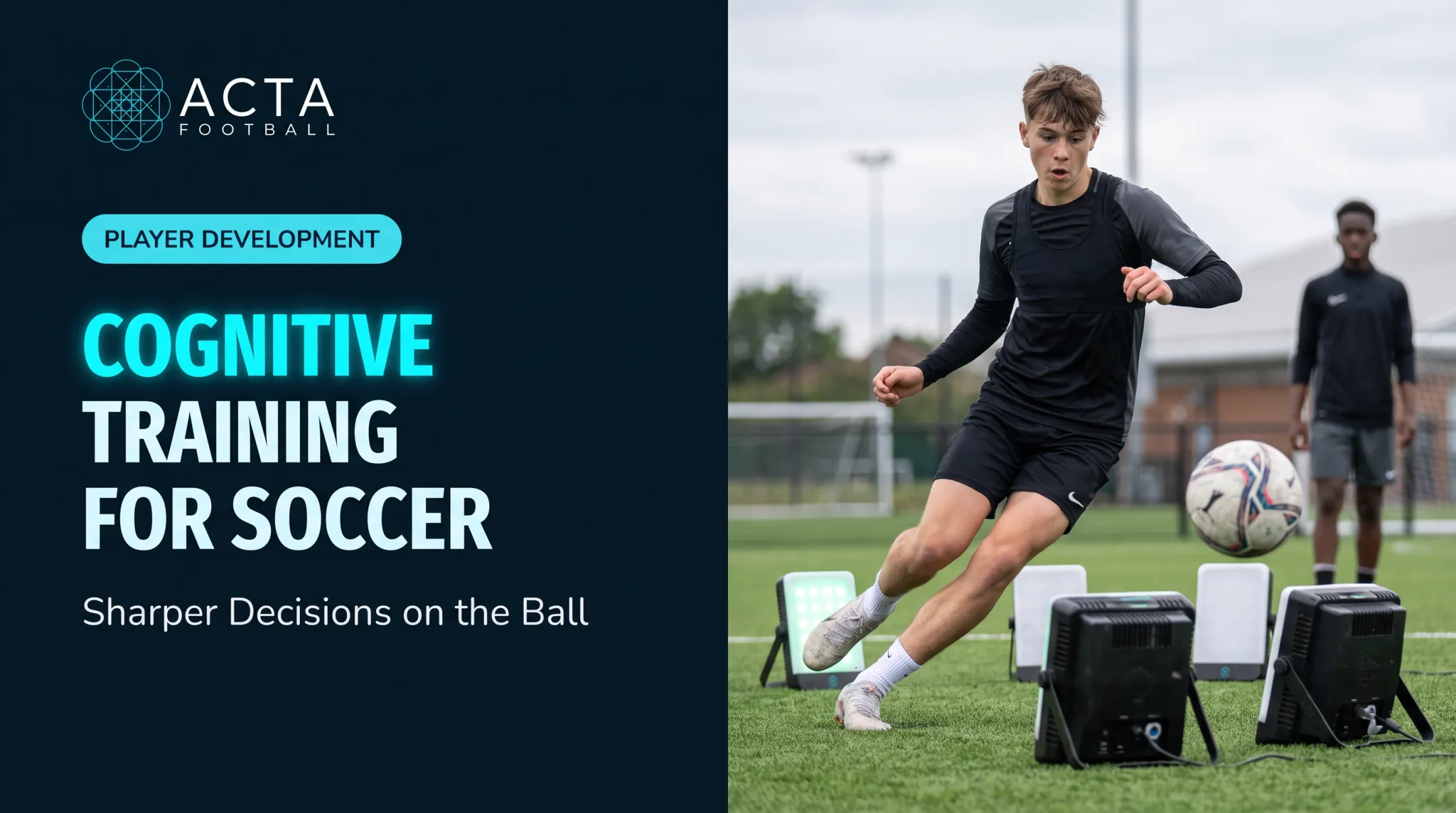
- Cone or light-based reaction drills – Player reacts to a visual or verbal cue, then sprints or changes direction toward the correct target. Adds unpredictability that cones alone can't replicate.
- Small-sided games (3v3 or 4v4) – Tight spaces force faster scanning and quicker decisions under real pressure. The U.S. Soccer Learning Center highlights 4v4 as a format that keeps game logic intact while simplifying options.
- 1v1 duel drills with a start signal – Back-to-back turn-and-react setups train competitive reaction speed against a live opponent.
- Solo drills using apps or rebound walls – Pair a physical action (dribble, pass, shoot) with a random visual or audio cue for repetition without a partner.
One mistake to avoid: turning reaction drills into pure conditioning. Fatigue slows true reaction training. Keep reps short, protect recovery time between sets, and stop before technique breaks down. Fatigued reps lock in bad habits instead of sharper reactions.

Position-Specific Reaction Training
Reaction demands differ by role, and generic drills leave gaps.
Goalkeepers:
- Master set-position habits first
- Progress from predictable shots to unpredictable finishes, deflections, and second-save scenarios
A study of elite youth players found goalkeepers had significantly faster response-initiation times than field players, matching the position’s specialized demands (Peráčková et al., 2025).
Defenders:
- React to the attacker's first touch, not the ball itself
- Practice closing space efficiently
- Train the tackle-or-contain decision—mistimed tackles usually cost more than patient positioning
Midfielders and attackers:
- Scan before receiving, not after
- Drill quick-decision passing under time constraints
- Reward the fastest correct decision, not just the fastest touch
Every position needs reaction work. Tailor the cues, timing, and consequences to the role, or the transfer to games stays incomplete.

How ACTA Football Trains Faster Game-Speed Reactions
Most reaction training happens in a vacuum: cones, lights, generic drills disconnected from how a specific player actually plays. ACTA Football built its approach around a different starting point: the player's own match film.
Game Speed Intelligence: Find, Rewire, Verify
ACTA's process runs in three steps:
- Find the bottleneck – Score the player's actual match film to pinpoint exactly where decisions break down
- Rewire processing – One-to-one film sessions and short modules link what the player sees to the next action so patterns missed in real time get caught earlier
- Verify the transfer – Re-score the film after the first training block to confirm the change is real, not assumed
Cognitive Speed Meets Executive Speed
ACTA separates two connected skills. Cognitive speed is how fast a player reads the game: recognizing patterns, anticipating space, spotting a teammate's run. Executive speed is how fast that perception turns into action under pressure.
Training addresses both sides of the same loop:
- Cognitive development through film review, opponent recognition, and vision training
- Executive development through Variable Reaction Training and pressure-based decision execution
- Combined reps that force players to read and act under match-like time pressure
Objective Feedback Through Action Lab AI
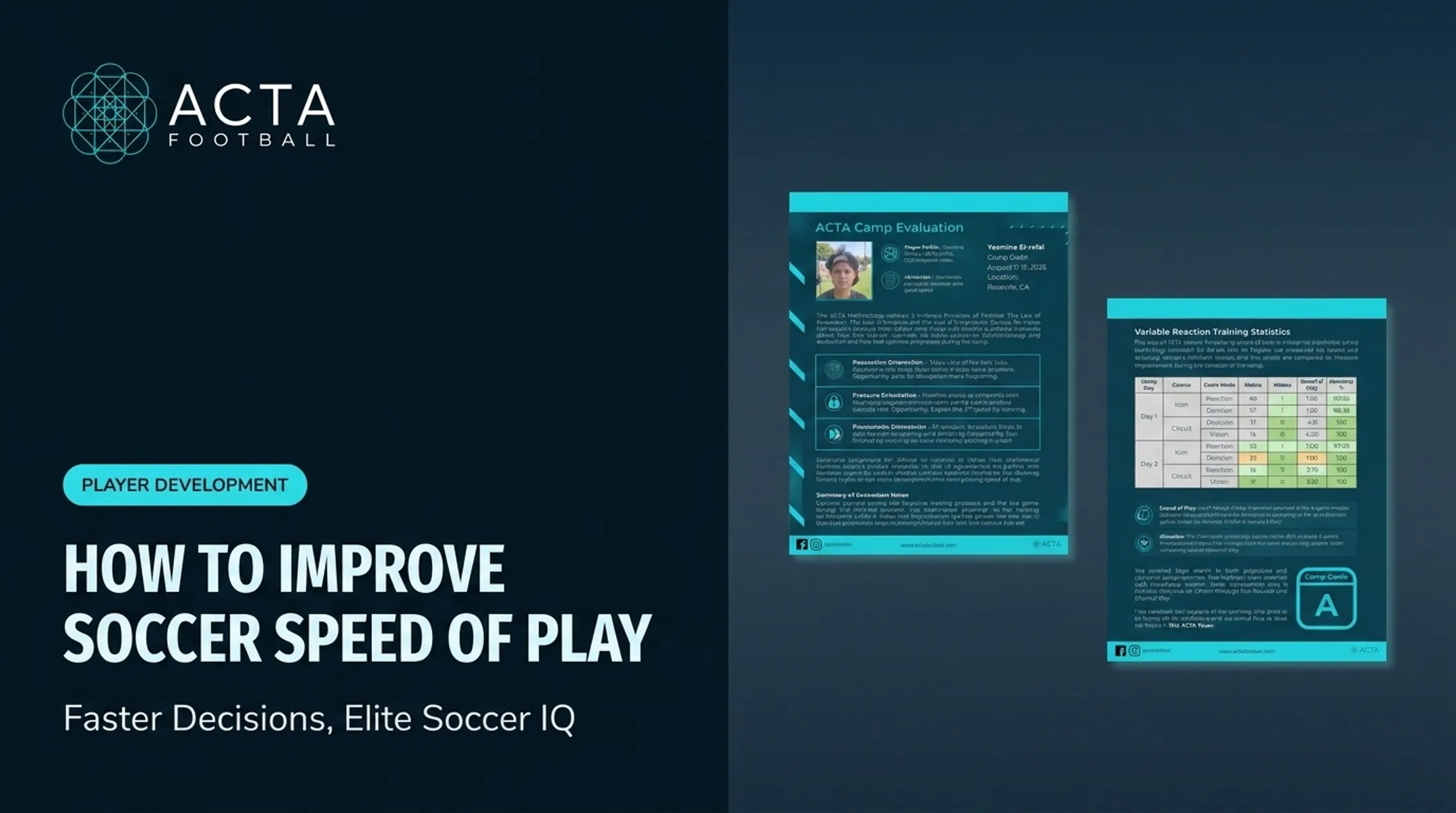
Rather than relying on a coach's impression alone, ACTA uses Action Lab AI to generate machine-measured scores for speed-of-play, accuracy, and reaction-training stats, plus written development recommendations.
The results are concrete: 20–30% faster decision-making among participants, and 93% of players show improvement after a single session.
This is the core of ACTA's approach: game reading is scored at each session, so a change in speed shows up in the record. For competitive players already grinding through technical training, that's the piece most programs skip: proof that the cognitive side actually moved.

Frequently Asked Questions
How do you train reaction time for soccer?
Mix unpredictable cue-based drills, small-sided games, and cognitive training that pairs decision-making with physical response. The best results come from realistic match conditions, not isolated drills in a vacuum.
What is the difference between reflex and reaction in soccer?
Reflex is instinctual and automatic, like a goalkeeper's automatic dive on a deflection. Reaction involves conscious decision-making, like choosing to pass, dribble, or shoot. Both are trainable through different drill types.
Can reaction time actually be improved with training?
Yes. Repeated exposure to unpredictable stimuli and structured cognitive drills builds faster neural pathways for perception and response. Reaction time isn't fixed at birth.
Which position benefits most from reaction training?
Goalkeepers showcase it most visibly, but every position benefits. All players scan, decide, and execute under pressure, just with different cues and timing.
How often should young players do reaction training?
A few short, focused sessions per week beat one long, fatiguing session. Quality of reaction work matters more than volume, and fatigue actually slows true reaction training.
Do reaction training tools like lights or apps actually help?
Light-based, sound-based, and app-based tools add unpredictability that's hard to replicate with cones alone. They work best as a complement to game-realistic training, not a replacement for it.